Tactile UI & Haptic Design: The 2026 Revolution
🍀 Directory Note
"A deep dive into the shift from 'Flat' to 'Sensorial' digital interfaces."
About Tactile UI & Haptic Design: The 2026 Revolution
# Tactile UI & Haptic Design: The Multi-Sensory UX Revolution of 2026
## The End of the "Flat" Era: Why Glass is No Longer Enough For over a decade, digital design was dominated by the "Glass Slab." We stared at flat pixels, tapped on cold glass, and interacted with an interface that was visually stimulating but physically dead. In 2026, that era has officially ended. We have entered the age of **Sensorial Digitalism**, where the boundary between the physical and the digital is blurred not just by visuals, but by texture, resistance, and haptic feedback.
---
[CHART DESCRIPTION: A pyramid diagram labeled 'The 2026 UX Hierarchy'. Base: Functionality (Calculated by AI). Middle: Aesthetics (Generated by AI). Top: Sensorial Feedback (Crafted by Humans: Haptics, Soundscapes, Spatial Awareness).]
---
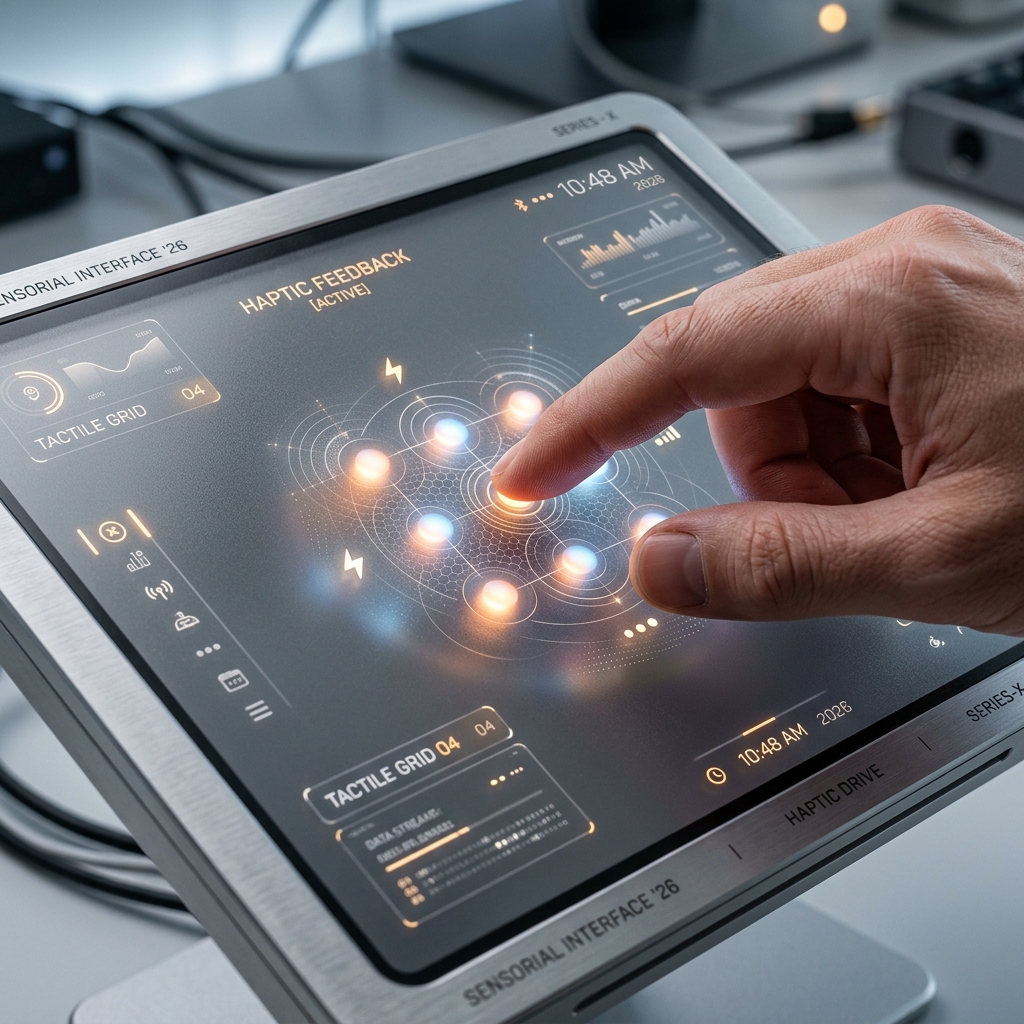
## 1. The Technology: Beyond the Vibration Motor The primitive "vibrate on tap" mechanism of 2020 has been replaced by sophisticated **Micro-Haptic Arrays**. In 2026, flagship devices use piezoelectric actuators and electrostatic friction to simulate the feel of specific materials.
### Digital "Friction" & Momentum When you scroll through a list in a 2026 mobile app, you doesn't just see the motion; you feel it. Designers can now program "Digital Friction," making a list of heavy files feel "slower" or "grittier" than a list of lightweight text notes.
---
## 2. The Aesthetic: Neo-Materialism and the Human Imperfection Visual design in 2026 has shifted to support this tactile reality. We call this **Neo-Materialism**. It is a reaction against the sterile, mathematically perfect designs of the early AI era.
### Refractive Glassmorphism 2.0 While 2024 was about blur, 2026 is about **Refraction**. UI elements now behave like physical glass, distorting the "light" of the background based on their thickness and curvature.
---
## Conclusion: The Humanization of the Pixel The 2026 shift toward haptic and tactile design is more than a trend; it's a reclamation of our senses in an increasingly digital world. By making the digital realm feel as rich and complex as the physical one, we aren't just improving "usability" - we are making technology more human.
--- *Lucky Graphics Editorial - Defining the visual and sensorial standards of the 2026 economy.*
Directory Analysis & Suitability
Key Advantages
- Future-proof theory
- Sensorial focus
Considerations
- Requires high-end hardware for testing
Platform Compatibility
Web Environment
Good
Mobile & Touch
Exceptional
Desktop Software
Good